The challenge
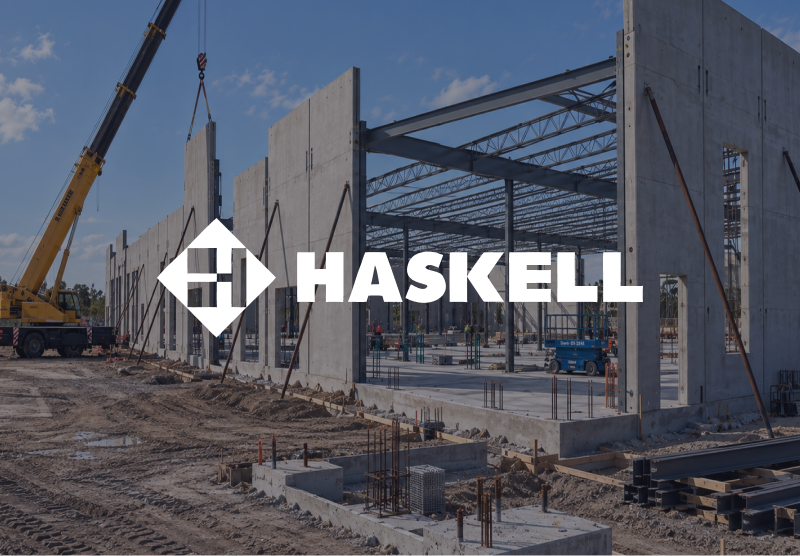
Designing a single-story tilt-up building requires a series of interdependent calculations. Engineers must evaluate seismic, wind, rain, snow and gravity loads, then apply the relevant results to individual walls, footings and foundations.
On some Haskell projects, that process can involve more than 20 Excel and Mathcad files. Inputs and results move manually among the files before engineers compile the work for review and reporting. A design change can require much of that process to be repeated, adding time and creating opportunities for errors in the handoffs.
Haskell’s Structural team is working with VIKTOR to test a different approach: an AI agent that coordinates validated engineering calculation apps while engineers retain responsibility for review and approval.
A trusted calculation library
Before introducing an agent, Haskell was already using VIKTOR App Builder to convert established calculations into reusable apps. Each app has defined inputs and outputs and follows Haskell’s validated engineering logic.
That distinction matters when using large language models (LLMs), which generate responses probabilistically, based on patterns in their training and the user’s request. Its output can vary. Haskell’s engineering apps are deterministic: Given the same inputs, they return the same result every time.
The apps provide a consistent, traceable basis for engineering review. Haskell engineers can create, update and validate them directly without writing code, then share approved versions across teams and connect them with existing engineering software. The result is a reusable calculation library rather than a collection of project-specific spreadsheets and Mathcad files.
The agent builds the workflow
The AI agent does not perform the engineering calculations itself. It assembles the workflow by selecting the validated apps required for a particular project and passing relevant inputs and outputs from one calculation to the next.
A Florida project, for example, may not require a snow-load calculation, and the agent can omit that step and build a workflow around applicable loads and conditions. If a project changes, the agent can update the workflow and carry revised information through subsequent calculations, giving engineers a clearer path from a changed input to its effect on wall, footing and foundation design.
The same approach supports scenario analysis. Engineers can adjust selected parameters, such as wall and parapet heights or gridline spans, then compare the resulting effects on foundation design. That allows the team to evaluate more options as it works toward a design that meets project requirements and considers cost or material use.
Early results and next steps
Early testing indicates that the agent can coordinate Haskell’s validated calculation apps and transfer inputs and outputs correctly between steps. On the projects evaluated so far, the workflow made the design of each wall gridline approximately four times faster by replacing separate Mathcad files with a coordinated, reviewable process.
When a design changes, affected calculations can be rerun and updates propagated in seconds, reducing work that might otherwise require hours of revisions and checks.
Engineering oversight remains central to the process. Calculation results continue to come from Haskell’s validated apps. Engineers can inspect inputs and outputs, review the agent’s actions and approve the work before it advances.
Next, Haskell and VIKTOR will explore automated reporting, integrations with ETABS, Revit and RAM and governance measures that keep agent actions secure, transparent and reviewable as the workflow expands.
Explore with us
The VIKTOR platform gives Haskell one place to turn established calculations into reusable engineering apps, validate them, and securely share them across teams. Each app retains Haskell’s predefined engineering logic, while an AI agent can connect the apps, transfer information between them, and coordinate the wider design workflow. Engineers can review every input and output, refine the workflow, and reuse it on future projects.
Also interested in automating your workflows with the help of AI? Book a demo with VIKTOR to discuss what this could look like for your team!
Let us show you how VIKTOR
can help you solve any challenge
Related Customer Cases


Get our best content in your inbox
Subscribe to our newsletter and get the latest industry insights