About Heijmans
Heijmans is a leading Dutch construction and engineering company, active in infrastructure, residential building, and property development. The company works on complex projects across the Netherlands, including energy networks, roads, and underground infrastructure. Within these projects, teams regularly design and execute horizontal directional drilling (HDD) operations, where precision, efficiency, and reliability are critical.
The traditional boring design process
Designing a bore at Heijmans followed a familiar pattern. Engineers would manually draw trajectories, map constraints like buildings and cables, apply machine parameters, and validate distances, all across different tools.
This process was not only time-consuming, taking roughly four hours per bore, but also repetitive and sensitive to human interpretation. At the same time, it wasn’t the part of the workflow where engineers made the biggest impact.
As Jeroen Ballast explains: “You don’t win projects by drawing these lines. But you still have to do it, and do it right.”
Automating the workflow
To tackle this, Heijmans worked with VIKTOR to automate their workflow with two connected applications: one for designing borelines, and one for performing the engineering calculations.
The applications are already being used by multiple engineers within Heijmans on HDD projects across the Netherlands. According to the team, the workflow is repeated multiple times per week, with some projects containing up to 30 individual bores that each require design validation and calculations.
Because the applications standardize and automate much of this repetitive work, the impact quickly scales across projects and teams.

1. Boreline Generator
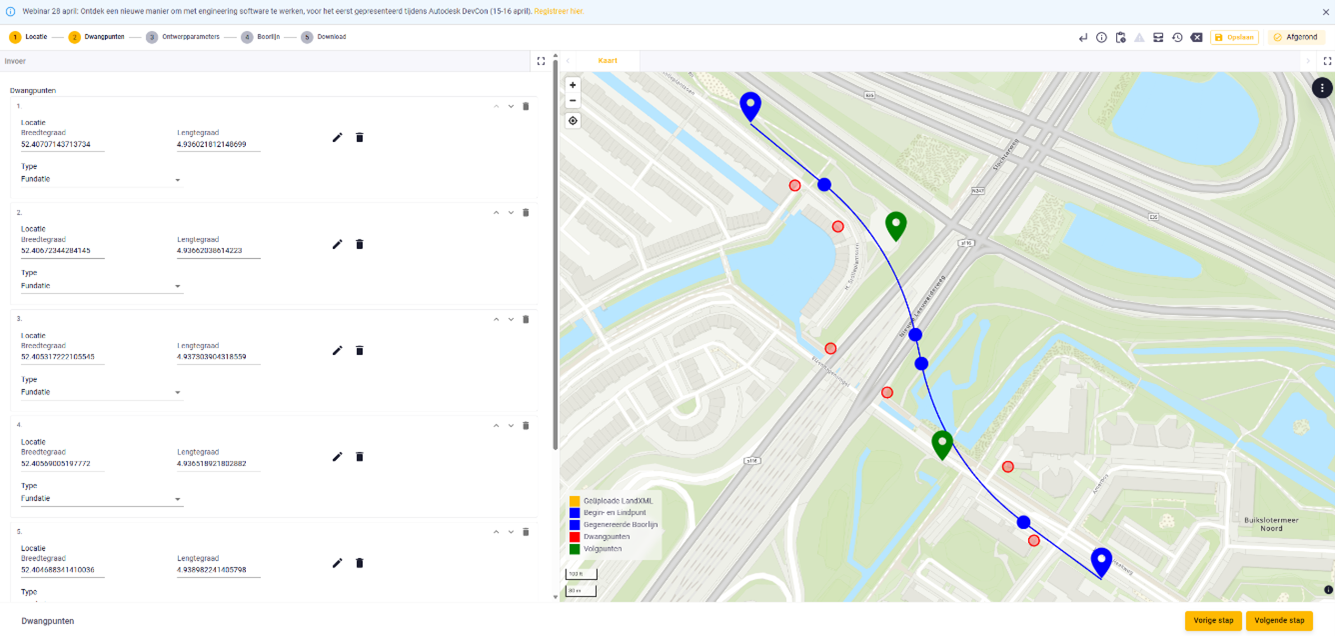
This app replaces manual drawing work by allowing engineers to define a bore simply by selecting a start and end point. From there, the system automatically generates a trajectory, applies machine-specific parameters, and checks constraints such as minimum distances to buildings or infrastructure. Errors are flagged instantly, and the final boreline can be exported directly into Autodesk’s AutoCAD Civil 3D, removing the need to redraw everything.
2. HDD Calculation App
This app takes this boreline and automates the calculation process. Soil data, machine properties, and material inputs are combined into a single model, which is generated and validated automatically. Where engineers previously had to build these models manually in Deltares D-Geo Pipeline, the app now handles that setup, resulting in faster and more consistent calculations.
"Where we used to take four hours for a bore design and calculation, we now do it in two. The apps are already being used multiple times per week by several engineers at Heijmans across projects containing up to 30 bores.”

Remco van As
Senior Engineer at Heijmans
Changing how the team works
By removing repetitive work, engineers can focus more on complex cases, project strategy, and communication with stakeholders. At the same time, the structured workflow makes it easier to onboard new engineers. Instead of relying on deep expertise in multiple tools, the process is embedded in the application, guiding users step by step. This also helps teams scale in a tight labor market. Knowledge is no longer only in people’s heads, but captured in a repeatable system.
Why VIKTOR?
For Heijmans, the value goes beyond automating a single task. By building the applications in VIKTOR, the workflow becomes reusable across projects and teams instead of living in spreadsheets, individual software setups, or one engineer’s expertise. Machine parameters, design rules, and calculation logic are stored centrally, meaning engineers work from the same standards every time and updates only need to be made once to be applied everywhere. This also makes it easier to expand the workflow over time.
What’s next?
The current applications already deliver significant value, but further improvements are underway. The next step is to integrate external data sources, allowing the system to automatically detect obstacles like buildings and apply the correct constraints without manual input. Ultimately, the goal is a fully connected workflow, where engineers define the intent, and the system handles the execution.
Start automating your workflows
Related Customer Cases

Get our best content in your inbox
Subscribe to our newsletter and get the latest industry insights