May 15, 2026
From Claude Code to Production: How Engineering Teams Scale AI Automation with VIKTOR

by VIKTOR
This is where they use the VIKTOR platform. These customers create apps with Copilot or Claude Code, as well as with VIKTOR’s App Builder, and use the VIKTOR platform for safe and controlled company wide deployment. We believe this is a very powerful combination, so we decided to create a series of blogs to get our customers up to speed on this.
In this blog, we will discuss how VIKTOR works with tools like Copilot and Claude Code. The next blogs go more into the practical implications: how do I get started? When do I use Claude vs the VIKTOR App Builder? How do I ensure governance and cost control?
AI is accelerating automation in the engineering industry
The engineering industry is relatively slow in adopting automation.
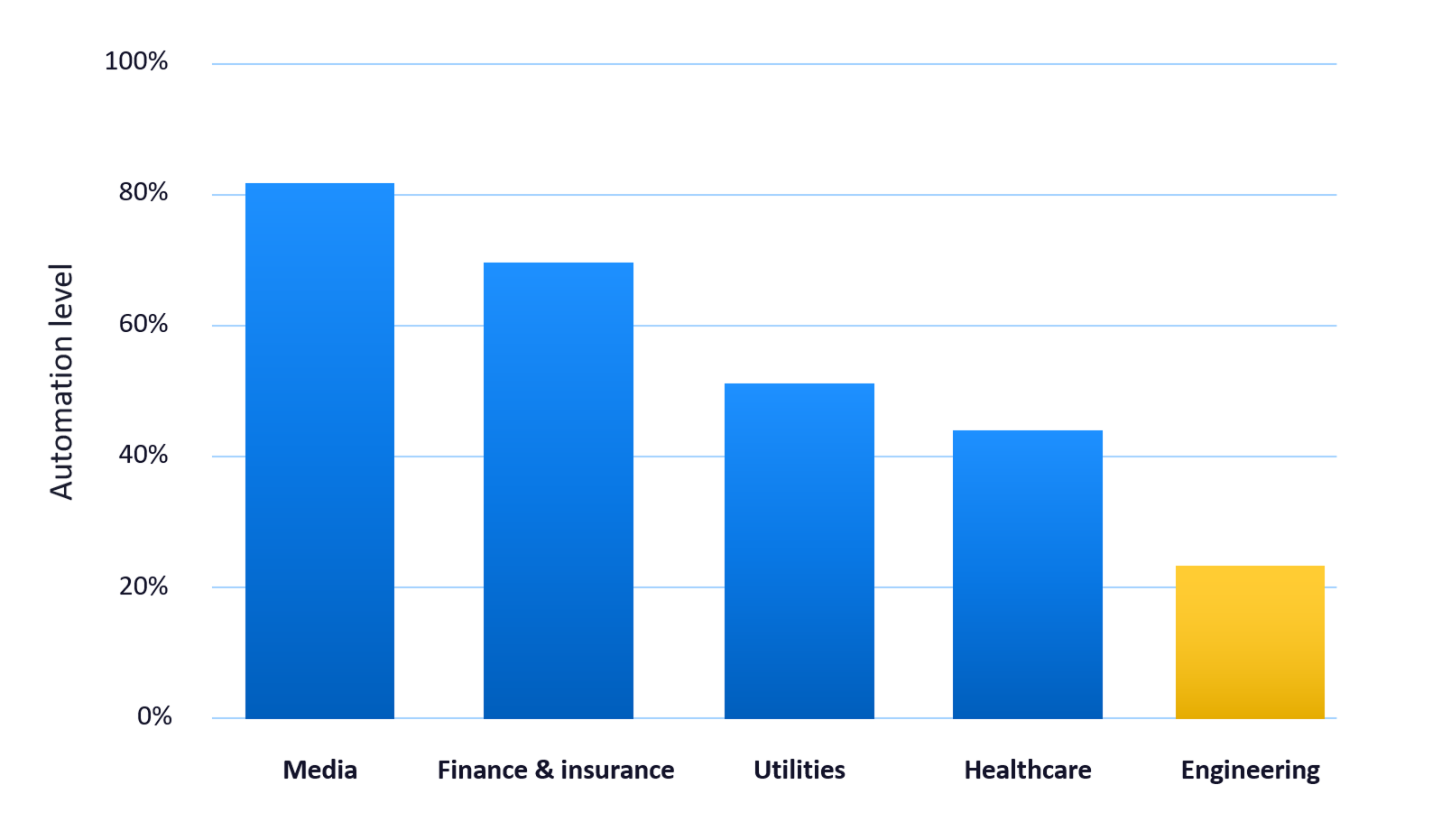
Sources: Computer Economics; eMarketer; Gartner; IDC Research; US Bureau of Economic Analysis; US Bureau of Labor Statistics; US Census Bureau; McKinsey Global Institute analysis
There are two reasons for this:
- Lack of time and skills. Engineering projects are under huge time pressure, and carving out project time to automate a process is hard. Availability of IT resources is very limited.
- Each project is uniqueness and complex. No two bridge designs, foundation calculations, or structural analyses are identical. That makes generalized automation difficult to apply directly.
AI has the potential to overcome these challenges:
- AI is very well-suited to automate structured engineering workflows. Engineering runs on structured logic: load calculations follow defined formulas, Eurocode checks are deterministic, structural analysis follows well-established methods. AI excels in creating code (such as Python) that translates engineering logic directly into code.
- AI allows a much larger group of people to automate their own work. Powers users create apps with AI-assisted coding tools, like Claude Code, Cursor, and Copilot. Other engineers use no-code tools like Lovable or the VIKTOR App Builder. And with AI, building an app is fast: what previously required a developer weeks of effort now takes a technically-minded engineer an afternoon.
But… with the fast adoption of AI, engineering organizations get concerned about wide-spread and uncontrolled usage of AI. For good reason:
AI is probabilistic: ask the same question twice, and you will get two different answers. And AI hallucinates, coming up with solutions that have very little to do with reality. Putting the power of AI in the hands of large groups may have unexpected side effects.
And in engineering, quality is non-negotiable, results have to be 100% correct.
So: How do you guarantee quality, consistency, and control at the scale of an engineering organization?
The governance and deployment challenge in engineering
Building the app is only the first step. The harder problem, the one that most AI tools do not address, is everything that happens next.
An app built with Claude Code lives on the developer's machine. There is no governed way to share it with 200 colleagues across three offices. There is no permission control, no audit trail, no version management. The app is powerful, but the impact is limited to the engineer who built it.
Getting an app from a developer's desktop into production across an engineering firm requires: distribution, access control, version management, quality assurance, compliance with engineering standards, audit trails, and AI cost control. These are essential. Engineering is a regulated industry where calculation accuracy is legally significant, making the difference between a useful tool and a liability.
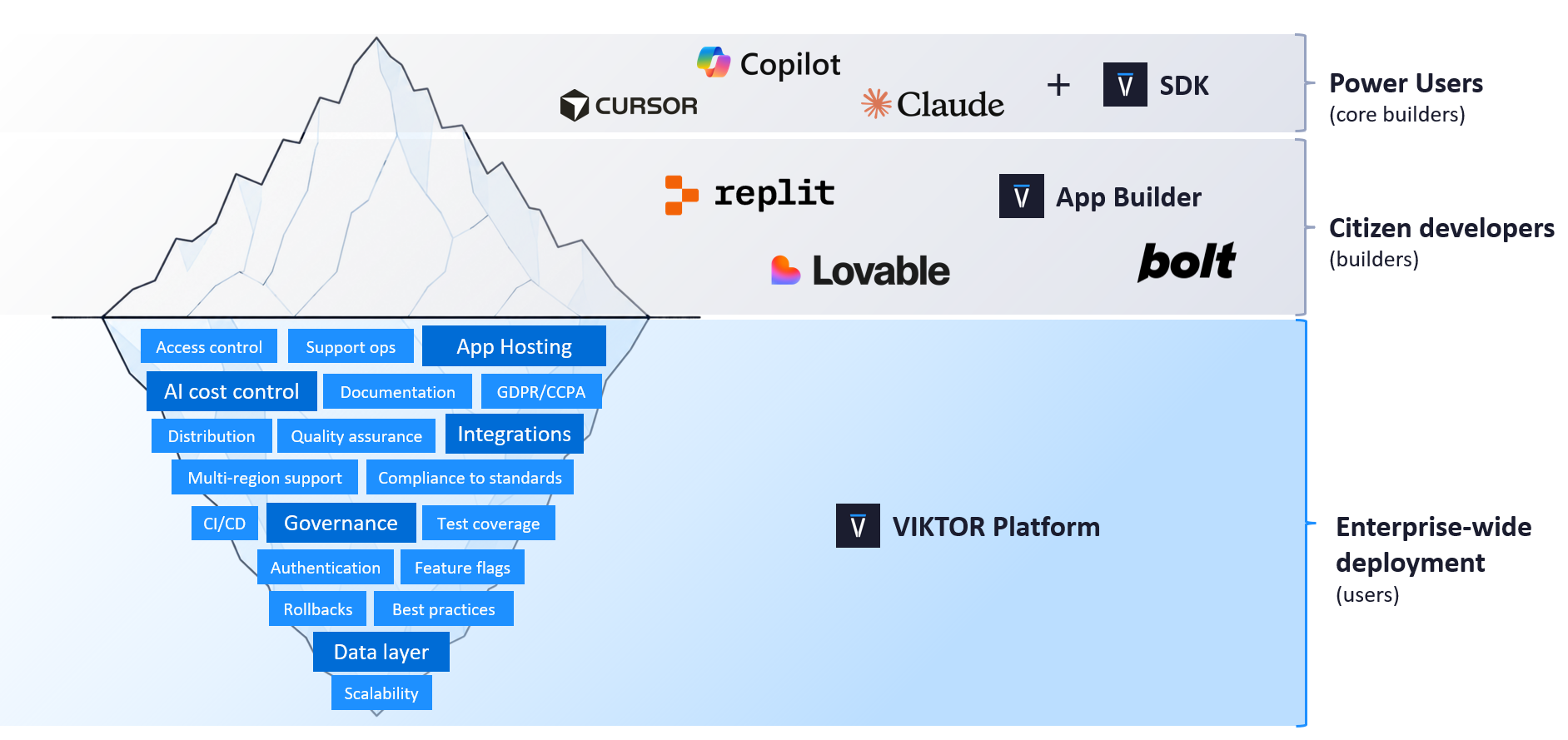
Building the app is only the visible part. The VIKTOR platform handles everything below the waterline.
This is the iceberg problem. What is visible, building the app, is just the tip. Everything below the waterline is what enterprises actually need to deploy these apps.
This is where the VIKTOR Platform comes in, handling everything below the waterline. The DTAP pipeline (Development, Testing, Acceptance, Production), App hosting, data layer, role-based permissions, audit trails, usage monitoring, and AI cost visibility are built into the platform, for apps built with Claude Code and apps built with the VIKTOR App Builder.
Four types of users
Within engineering firms, there are now four distinct groups, involved in building and using engineering apps:
-
IT builds the most complex, business-critical applications. But they are also limited in resources, and can cover the top of the complexity curve, not the long tail of custom engineering workflows that need automating. But more importantly, they are also responsible for quality and oversight of all automation efforts, ensuring quality and correctness.
-
Power users (5% to 10% of engineers) are engineers who can write code and are now starting to use tools like Claude Code, Cursor, and Copilot. They are building sophisticated automation apps, and faster than ever before.
-
Citizen developers (roughly 25% of engineers) are engineers who understand exactly what needs automating. Their experience in coding is limited, but they can read and validate code. They use AI-assisted no-code (or “vibe coding”) tools. These can be generic like Lovable, Replit or Bolt, or build specifically for engineering like VIKTOR’s App Builder.
-
End users (all engineers) are using the apps in their workflows. They benefit from faster execution and better results, and must be able to rely the quality of the results.
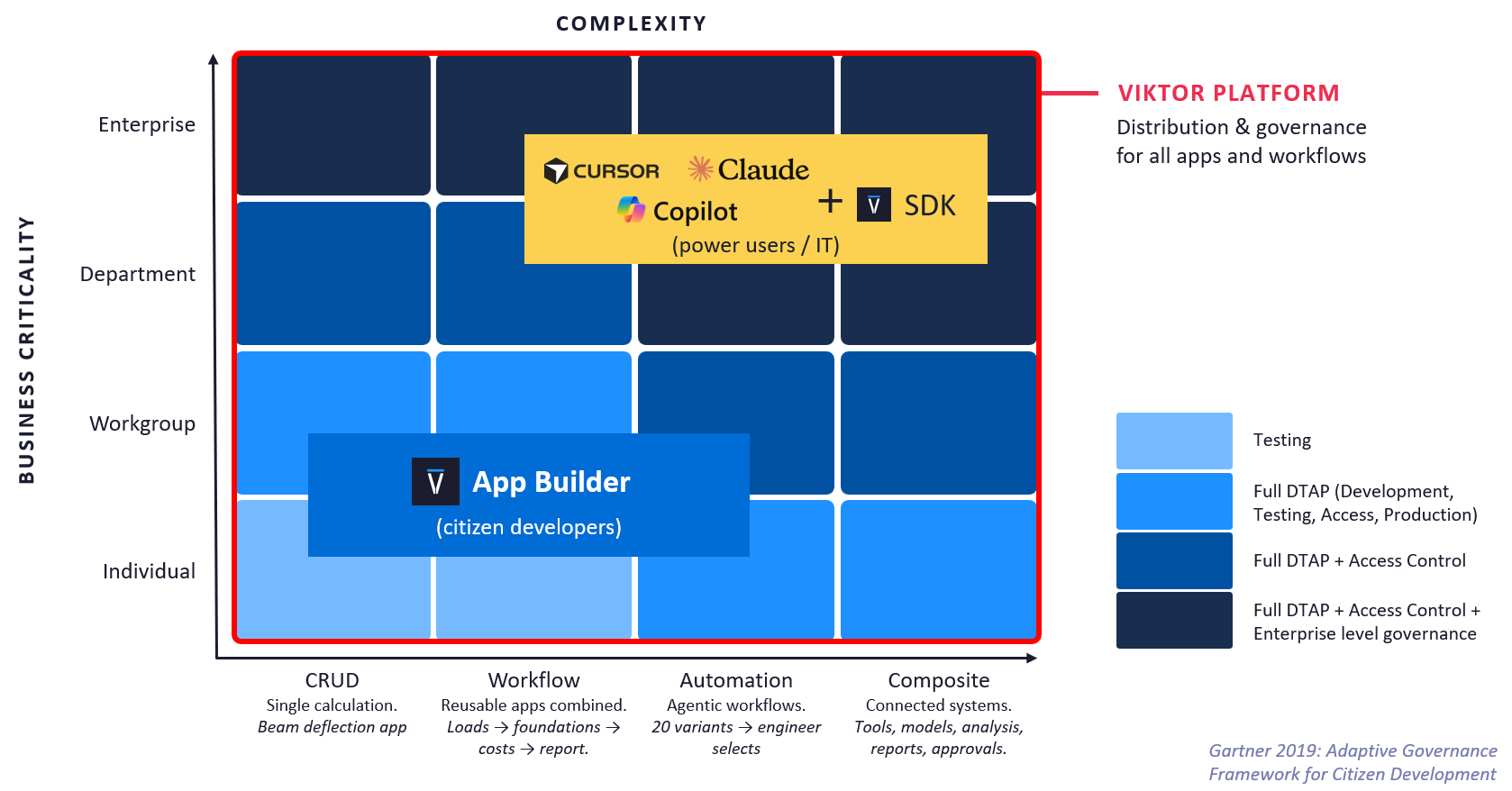
Source: Gartner 2019: Adaptive Governance Framework for Citizen Development
These groups all cover their own part of the spectrum, with IT on the complex and business critical applications, and citizen developers creating high volumes of smaller apps to support their day-to-day work. The power user is a growing group that covers the middle ground.
Using the VIKTOR Platform
An engineering firm that deploys VIKTOR as its platform gets all these groups working together:
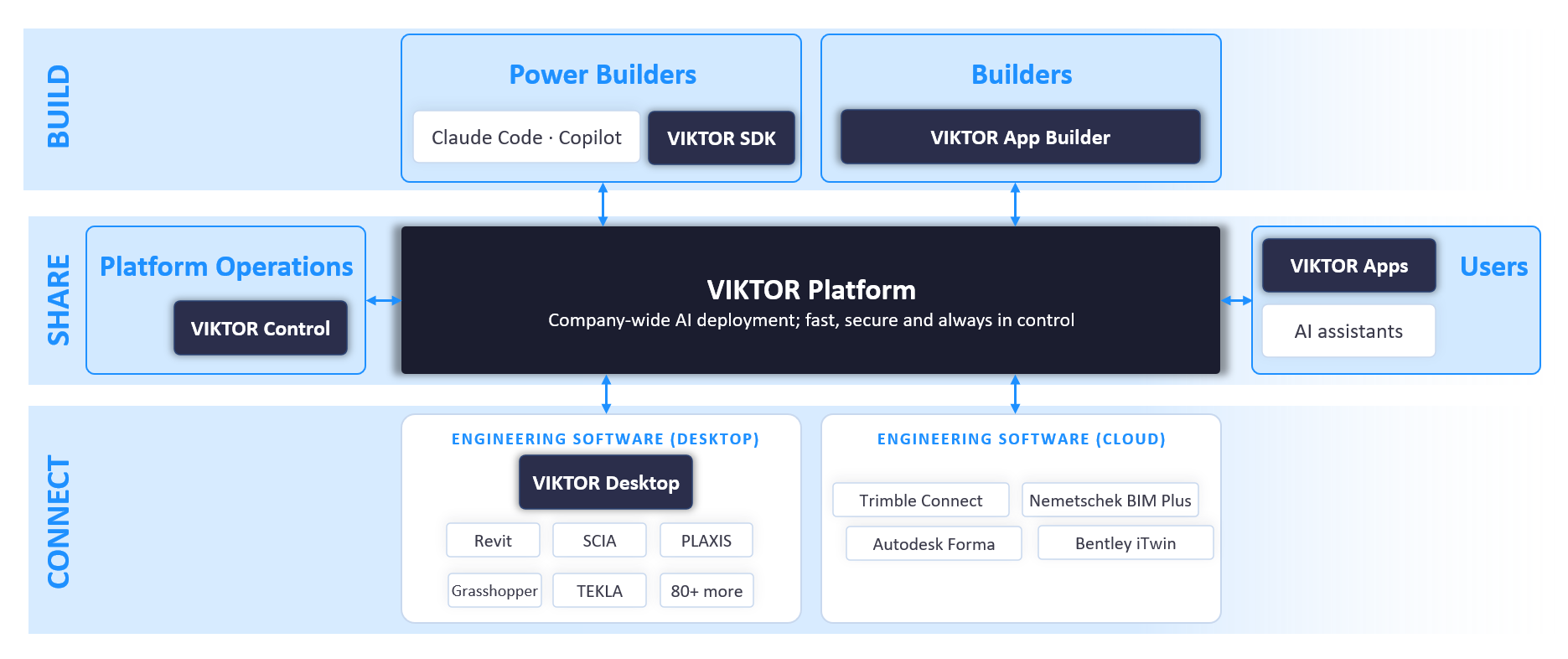
- Power users use AI assisted coding tools and VIKTOR's engineering SDK to build high quality apps
- Citizen developers using the VIKTOR App Builder to build apps and automate workflows they know best
- IT oversees and manages the governance and deployment of these apps and workflows, using the VIKTOR platform
- End users running validated, reliable automation from a centralized app store, without needing to build or configure anything
So, if you are looking to use an AI assisted coding tool such as Copilot or Claude Code to automate your engineering processes, then use VIKTOR to
- build better apps with our SDK and knowledge base,
- connect easily with the engineering software you already use, and
- share apps safely enterprise wide with the VIKTOR platform, with built-in governance and control.
Coming up in this series
This post is the first in a series on how engineering teams are using AI assisted coding tools and VIKTOR together. Coming next:
- Part 2: getting started with Claude Code and VIKTOR
- Part 3: Using AI assisted coding and the VIKTOR platform: best practices and tips
- Part 4: From the work floor, how our own VIKTOR consultants use Claude Code and Copilot every day
- Part 5: Supercharging agents: connecting Claude and other AI agents to VIKTOR with MCP
- Part 6: The AI cost problem in engineering and how to solve it
- Part 7: Governance, compliance, and why IT teams choose VIKTOR
Start automating your workflows
Related Blog Posts
Get our best content in your inbox
Subscribe to our newsletter and get the latest industry insights