
Watch the webinar
If you missed the session or want to revisit any part of it, the full webinar recording is available on demand here: Watch the recording.
In this blog, we'll explore what we're building, the core principles that support our vision, and how we're going to implement it. Here's what we'll cover:
- How AI has changed the way we work
- How this impacts the work of an engineer
- How we use AI with engineering work, balancing AI creativity and engineering reliability
- Development of deterministic and verified tools
- Creation of deterministic and verified workflows
- Orchestration with probabilistic and creative agents
- How we are going to achieve it – our development themes for 2026 and beyond
- Build powerful apps quickly
- Connect your software with automated workflows
- Share and manage tools centrally
How AI has changed the way we work
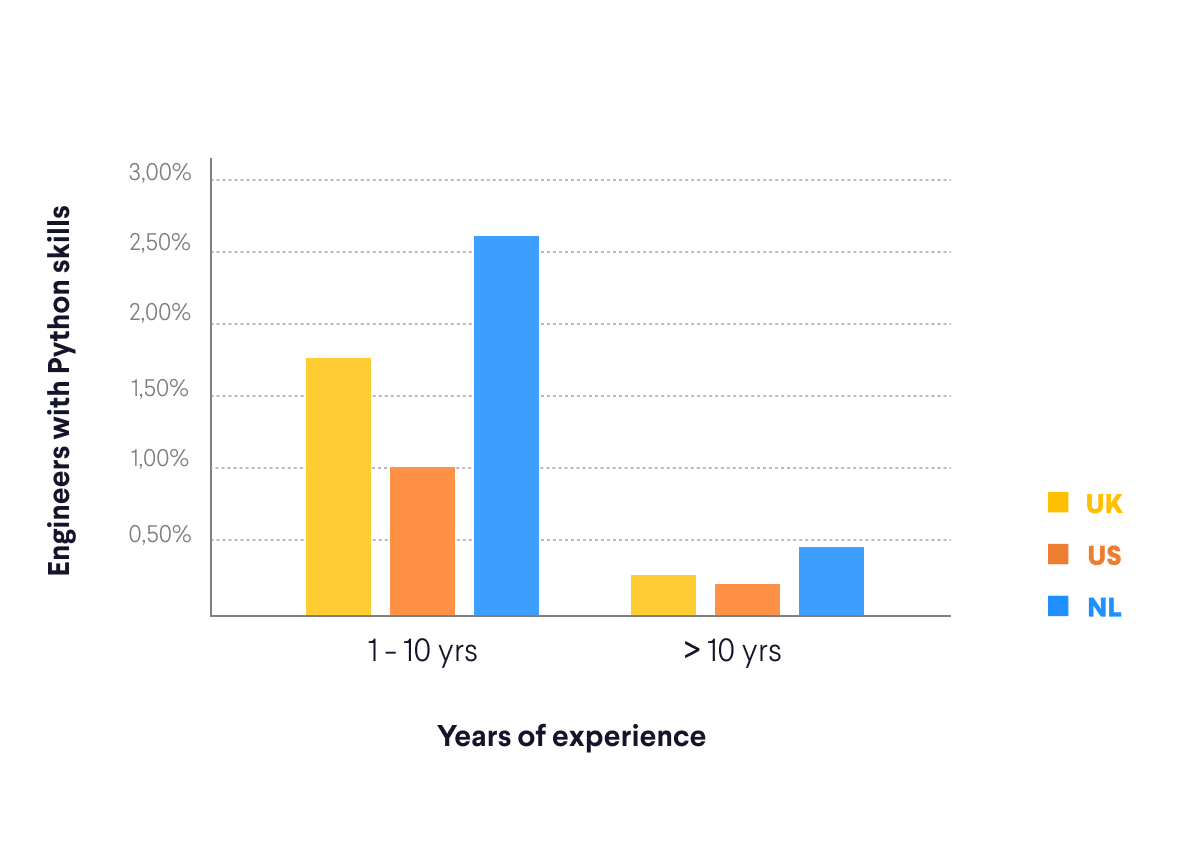
Since the launch of ChatGPT in late 2022, automation in engineering has transformed rapidly. Before AI, only 1-2.5% of engineers could automate tasks with for example Python, as accessibility was limited by the time and skill required. Today, that number is growing fast thanks to AI assistants that make coding accessible to everyone.
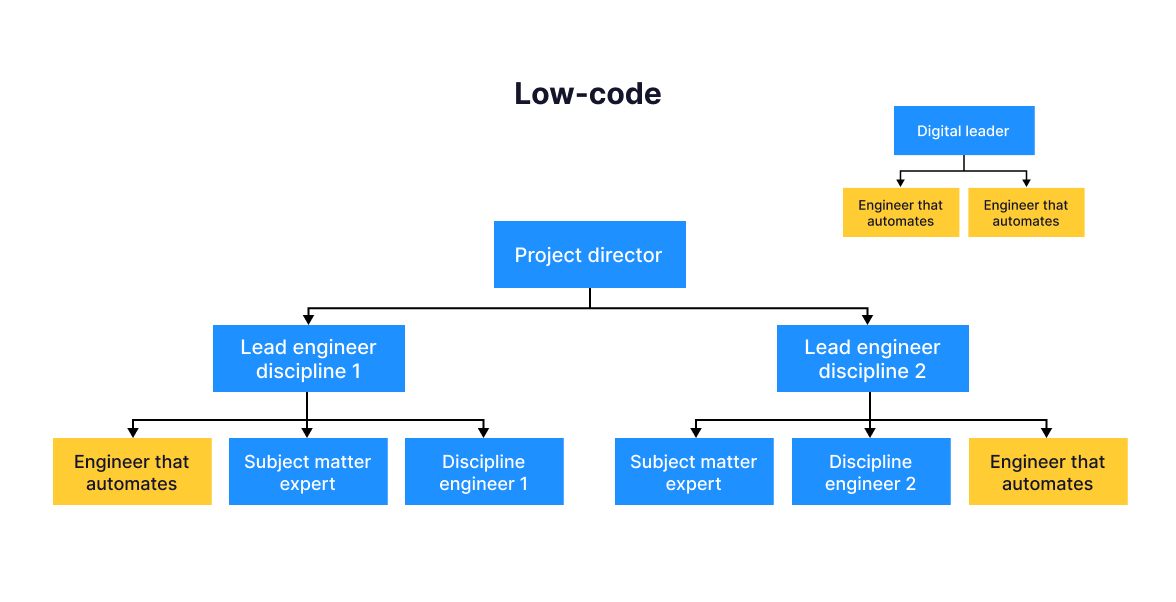
This shift has changed how companies are structured. It started with small groups of enthusiasts who automated tasks during their free time. Then came new roles like "digital leaders" dedicated to automation. But now, something bigger is happening.
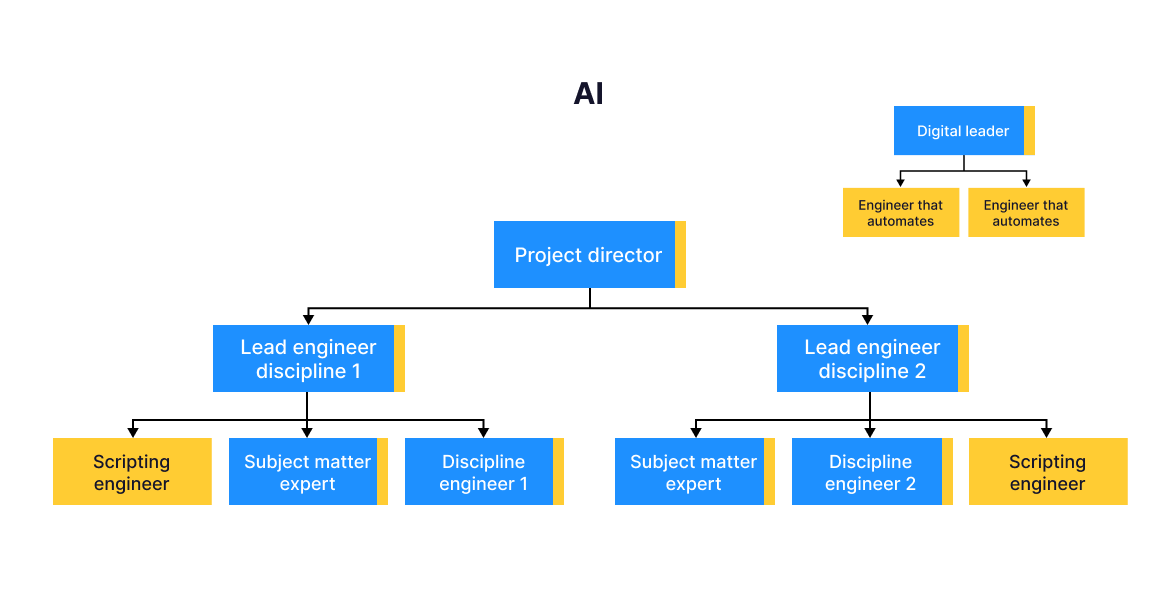
AI makes it easy to automate and code engineering tasks. These automations drive productivity increases of 2 to 10 times across organizations. Why? Because automation is no longer limited to a few specialists. Every engineer, at every level, can now become an automation engineer.
How the mind of the engineer works
To support this new paradigm and to ground our vision for the upcoming years, we need to go back to a few principles and understand how the mind of the engineer works.
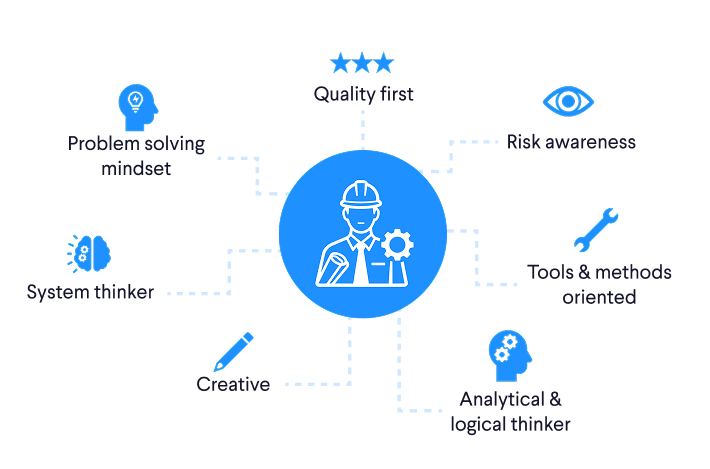
Engineers think deterministic. They work with logic and code where outcomes are predictable. They rely on certainty, fixed rules, and laws. This way of working has delivered reliable and verifiable solutions for decades.
AI, on the other hand, is probabilistic. It works with models and uncertainty, producing outcomes based on likelihood and possibility. While powerful, it lacks the deterministic guarantees that engineers need.
The key question is: how can we combine the way of working of an engineer with the superpower of AI?
How we combine AI with engineering work
Its important to understand that, while AI is probabilistic, it is really good at coding, building programs based on (prompt) specifications from experts. AI is already outperforming most programmers and will continue to improve. And these programs are deterministic, and can be tested and validated. Exactly as engineers want.
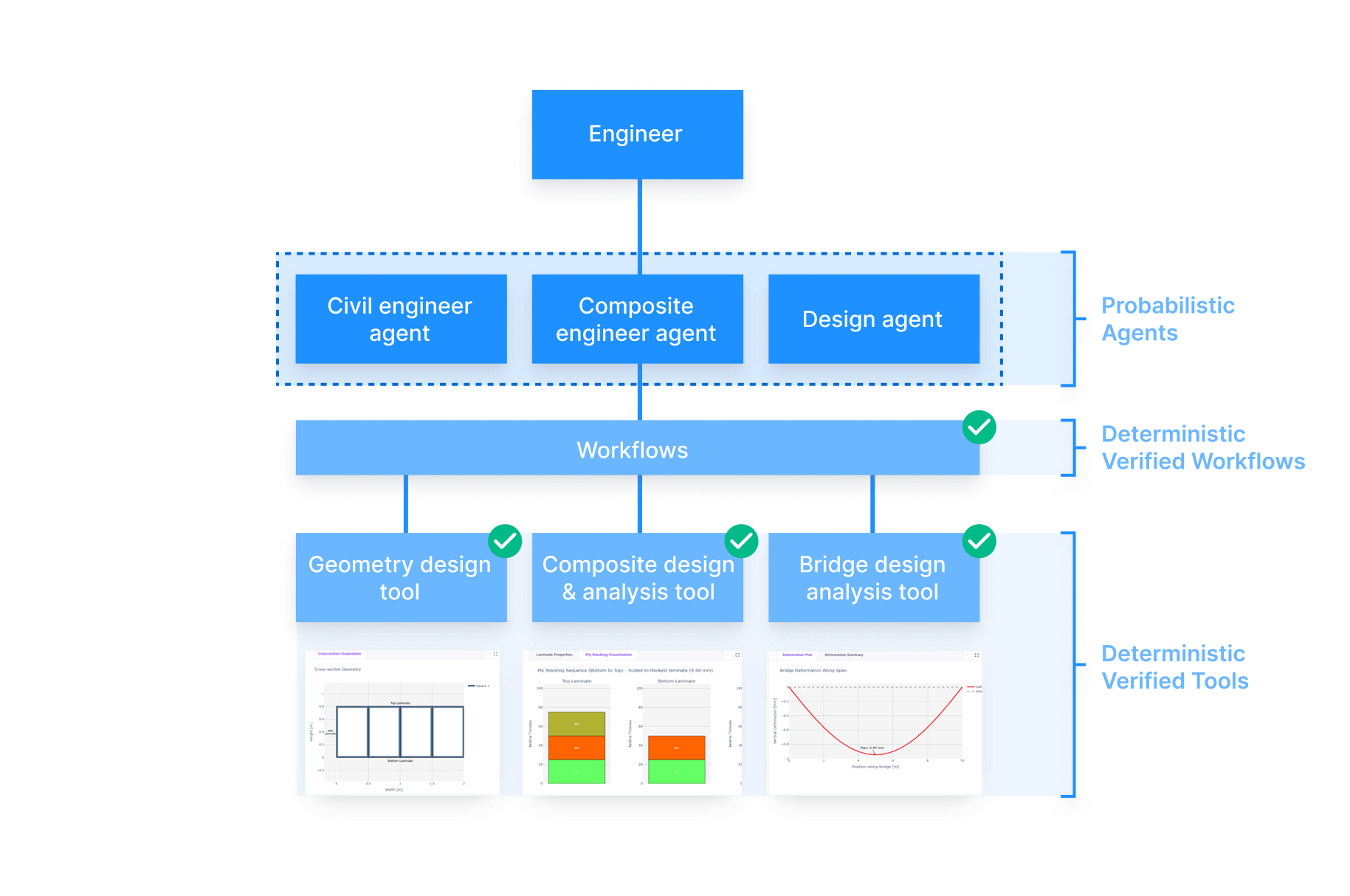
VIKTOR’s approach is based on three-layer that respect the deterministic nature of engineering while leveraging the power of AI:
- Development of deterministic verified tools
- Creation of deterministic verified workflows, that combine self developed and external tools
- Orchestration of probabilistic agents
For building these tools and workflows, we use AI. The VIKTOR app builder and workflow builder automatically create high quality code, based on prompts and instructions from the engineer.
Development of deterministic verified tools
The first layer is building tools that engineers can trust. Tools like the App Builder use AI to help you write code faster, but the output is still deterministic code. By combining AI-assisted development with a thorough testing process, you create applications that always yield the same output for the same input.
Creation of a deterministic verified workflow
Engineering projects are naturally multi-step and multidisciplinary. Once you have automated individual steps with verified tools (from the previous layer), the next step is connecting them together. Again with the help of AI, VIKTOR allows you to easily create an end-to-end workflow where each step is deterministic and verified. You know exactly what happens at each stage, and the entire process remains under your control.
Orchestration of with probabilistic AI agents
The final layer is where AI's probabilistic nature becomes truly powerful. AI agents orchestrate your verified workflows, run them over different inputs, and generate insights or outputs like reports, calculation summaries, or conclusions. The key difference is that the AI is not making engineering decisions—it's orchestrating a process built on deterministic tools that have been verified by engineers. And its using your guidance and input to determine what to design and validate. You're reviewing the outcome of a trusted process, not trusting the AI blindly.
How we are going to achieve it
We're focusing on three key areas to unlock value in 2026:
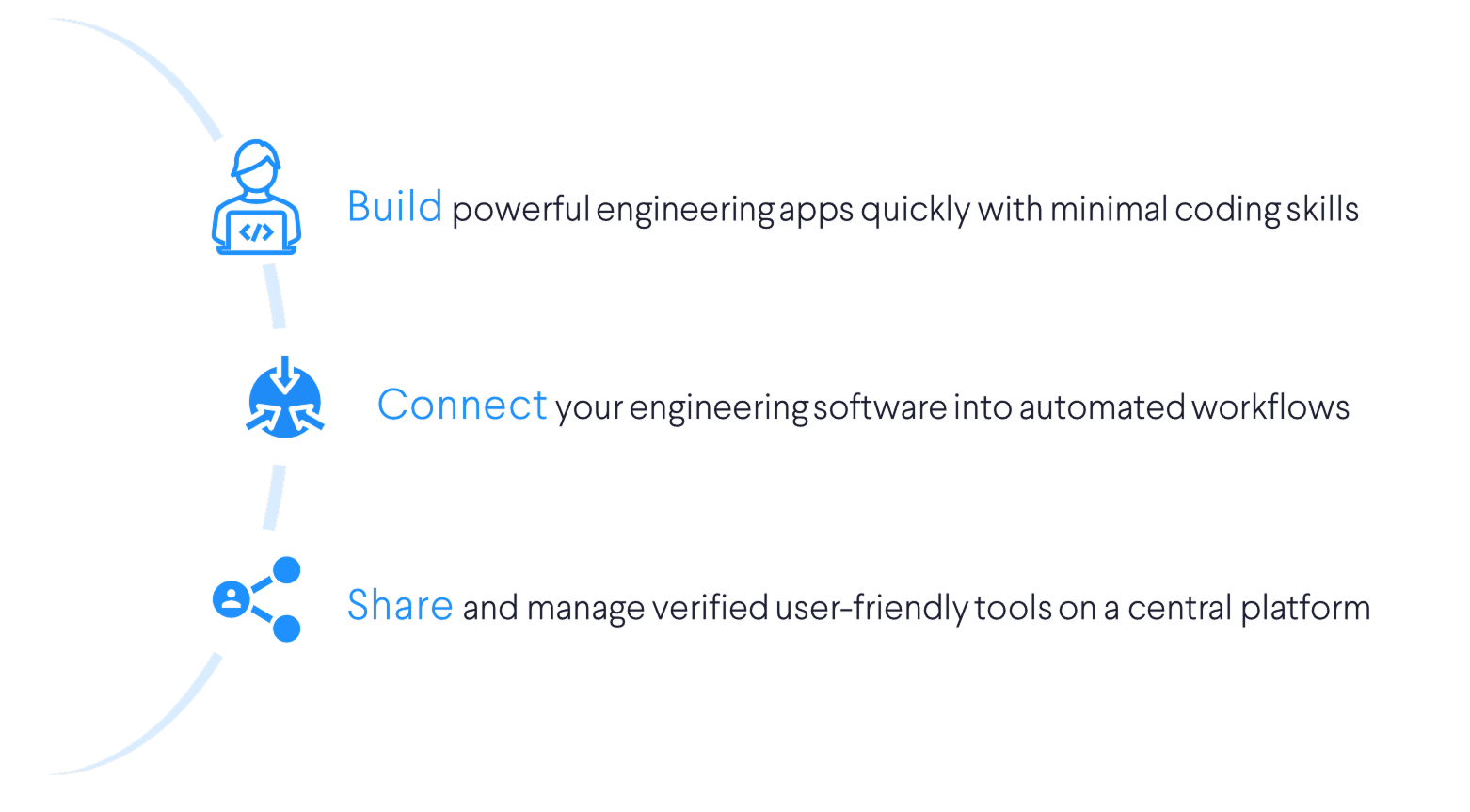
- Build powerful apps quickly
- Connect your software with automated workflows
- Share and manage tools centrally
Let's dive into each pillar and see how they work together to transform your engineering workflow.
Build powerful engineering apps quickly
Our primary goal is to enable every engineer to build VIKTOR apps, regardless of coding skill level. To achieve this, we're making significant improvements on two fronts.
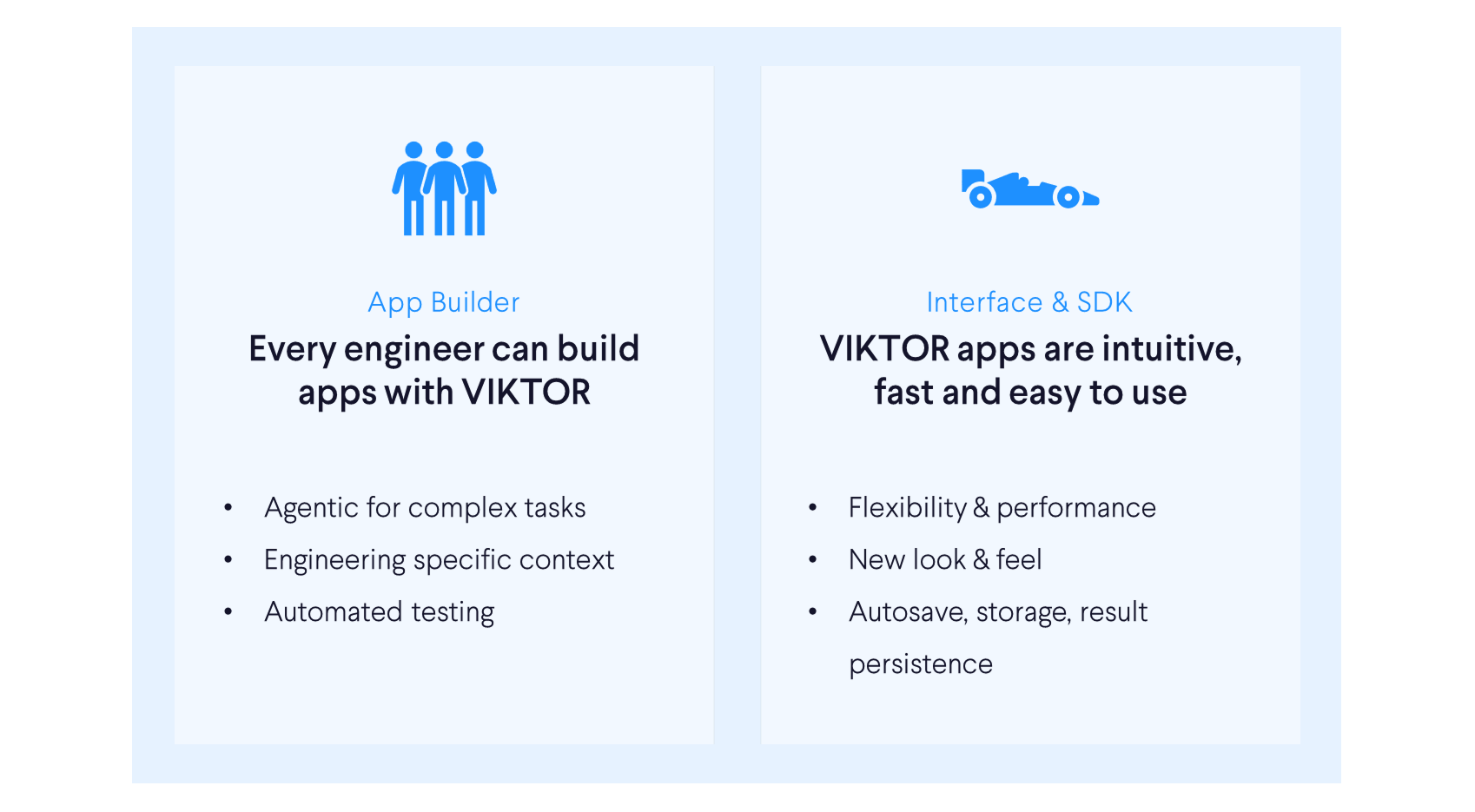
App Builder improvements:
- Engineering-specific context for more tasks and domains
- Automated testing to verify outputs
- Advanced agentic capabilities for complex engineering problems
Platform enhancements:
- Modern, flexible interface with improved look and feel
- Better performance and auto-save functionality
- Enhanced storage and result persistence
Connect your software with automated workflows
Once you've built your apps, the next challenge is integrating them with your existing engineering tools. Based on client feedback, we're expanding our integration capabilities and introducing powerful new workflow features.
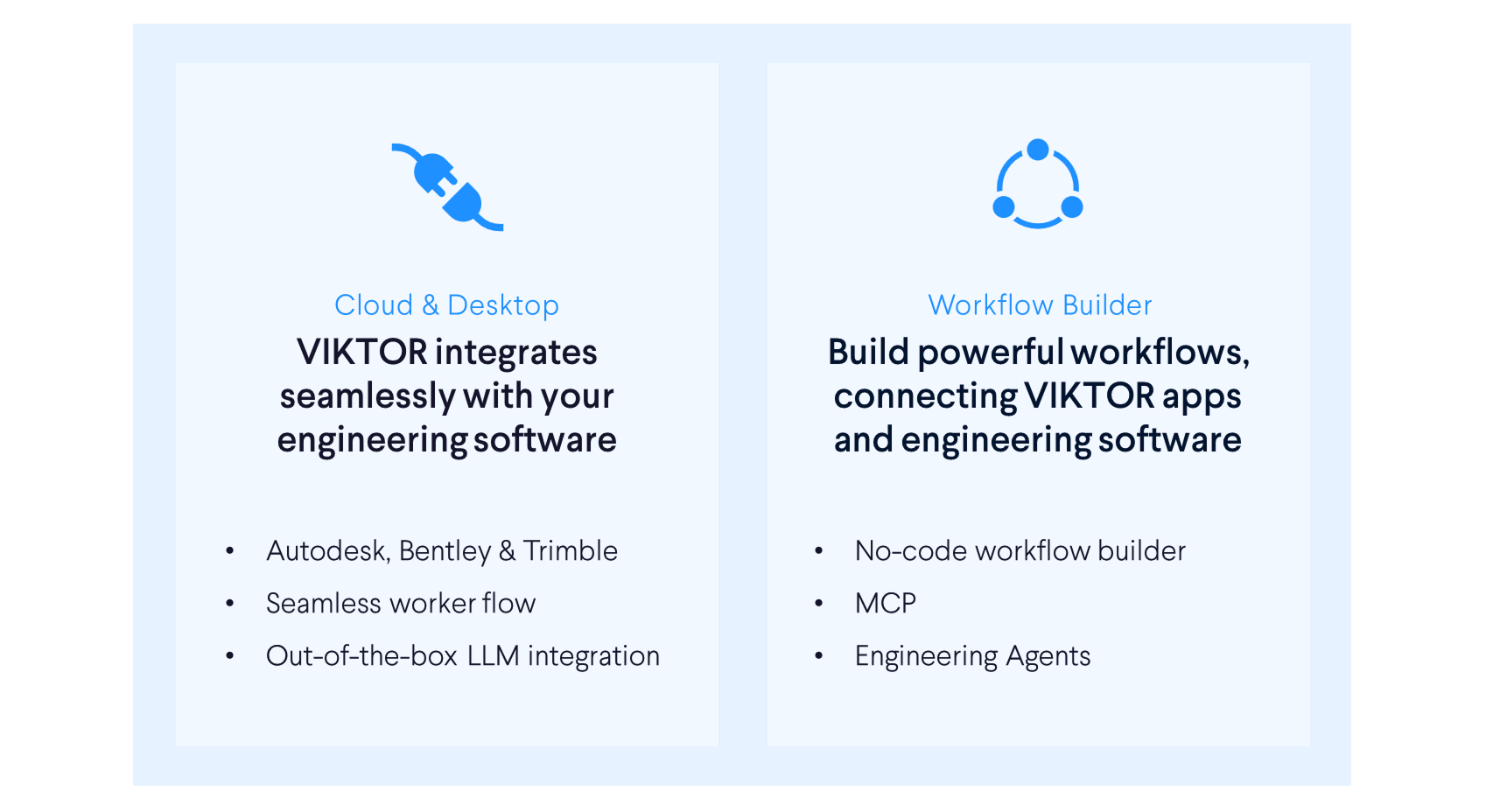
Key integration improvements:
- Deeper integrations with Autodesk, Bentley, and Trimble software
- Improved integration also known as workers flow for local software connections
- Out-of-the-box Large Language Model integration
- No-code workflow builder to orchestrate engineering agents and software
This means you'll be able to seamlessly connect VIKTOR apps with each other, with engineering software, and with AI agents, all without complex coding.
Share and manage tools on a central platform
Building and connecting apps is only half the journey. The real value comes when you can confidently share them across your organization. We're focusing on two essential aspects to make this happen.
Easy app distribution across your organization with advanced permissions, comments, and feedback systems.
App governance (DTAP flow):
- Development: Collaborative tools for building complex apps
- Testing: Invite colleagues to test and provide feedback
- Acceptance: Verify and approve apps through a validation process
- Production: Deploy verified, production-ready apps
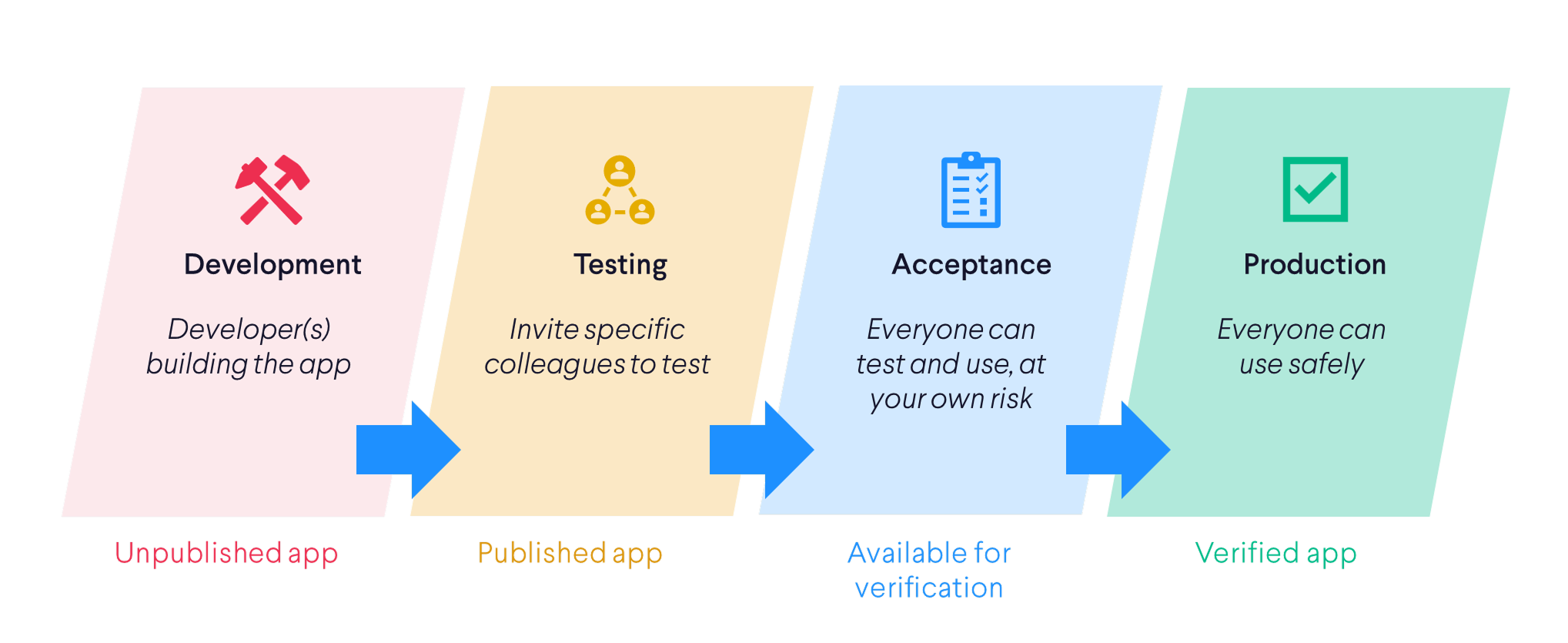
This structured approach ensures every app meets your quality standards before reaching production, giving you both speed and control.
Join us on this journey
Our vision is to empower all engineers to build, connect, and share apps, workflows, and agents delivering high-value solutions with speed & control. We've explored how deterministic engineering thinking combines with AI through our three-layer approach and shared the roadmap to make it happen in 2026.
Whether you're just starting with AI-assisted development or ready to transform your entire organization, we're here to support you every step of the way. Join us now and experience how VIKTOR empowers you to build, connect, and share engineering solutions faster than ever before.
Start building apps for free
Related Blog Posts
October 09, 2026
How to automate warehouse quantity takeoff in Trimble Connect with VIKTOR AI
Read more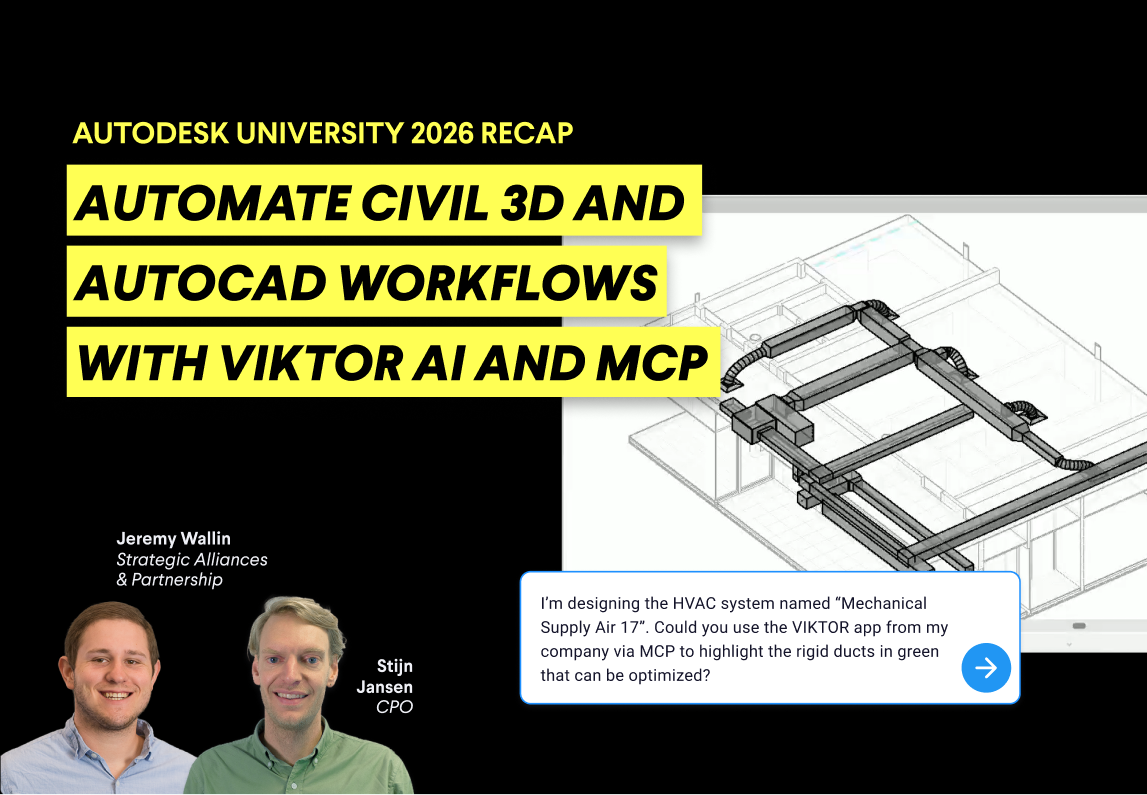
October 02, 2026
Autodesk University 2026 recap: Automate Civil 3D and AutoCAD workflows with VIKTOR AI and MCP
Read more
September 14, 2026