
If you missed the session or want to revisit any part of it, the full webinar recording is available on demand here: Watch the recording.
Here’s what we’ll cover in this blog:
- Current challenges and AI opportunities in our industry
- How VIKTOR brings AI into engineering workflows (safely and reliably)
- A closer look into structural engineering
- Demo 1: Using AI to build a structural engineering app from a PDF
- Demo 2: AI agents running a footing design workflow
Current challenges and AI opportunities in our industry
Stijn started by outlining the challenges we currently face and showed how other industries are gaining from AI. He then asked the key question: what is holding us up?
Well, the answer is clear. The main challenge is the lack of skills and time: it takes between 3 to 6 weeks to create an app.
That's where AI comes in as the game changer. Stijn referenced a Gartner report that warns leaders that teams who do not include AI agent orchestration risk a lasting competitive disadvantage.
How VIKTOR brings AI into engineering workflows
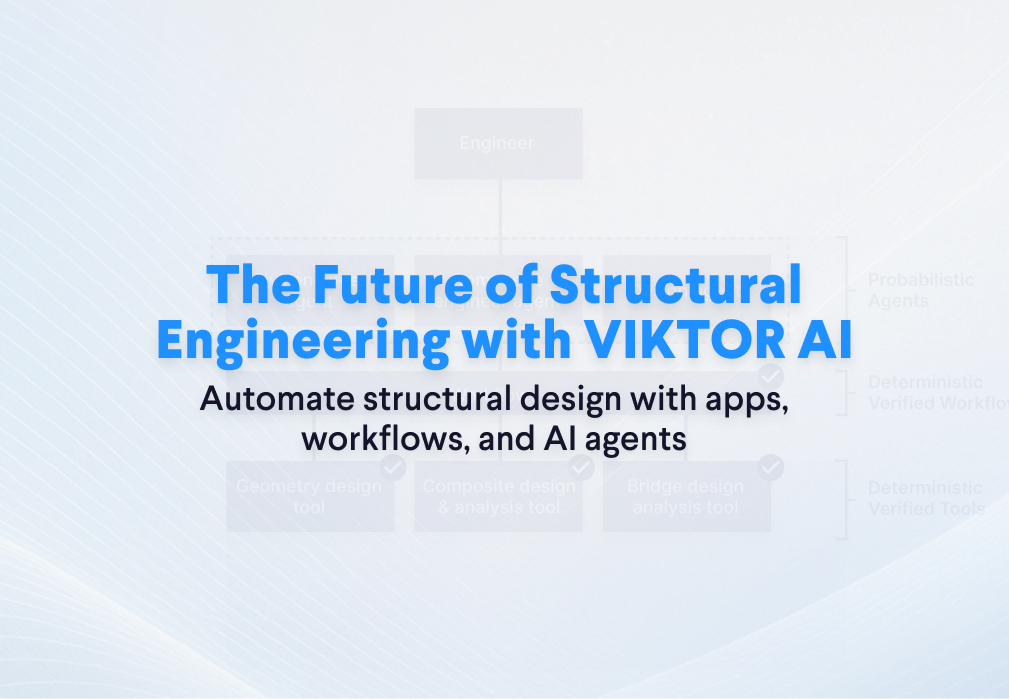
Stijn then covered what VIKTOR has already delivered (like the App Builder) and what we’re working toward next: reliable workflows and AI agent orchestration built on deterministic, human verified engineering tools.
But he also explained how to use AI the right way. Engineering is deterministic, but AI agents are probabilistic. The same input does not always yield the same output.
So the solution is to build human verified apps that yield deterministic results. Then workflows can be created based on these deterministic tools, and AI agents can work on top of that.
A closer look into structural engineering
After Stijn's presentation, I shared my experience working in utilities and mining, where I designed structures like transmission towers and gantries.
I showed a VIKTOR application that saved me a lot of time when modeling these complex structures (in this case a transmission tower). The attendees really connected with this example. I won't go into details here, since we already covered that app in this blog.
This example showed the past and present of automation, and it set the stage to explain how we bring AI into engineering safely, first by building deterministic, human verified tools, then by using AI to orchestrate workflows on top of them.
To make this concrete, I showcased two demos.
Demo 1: Create structural engineering apps by uploading a PDF
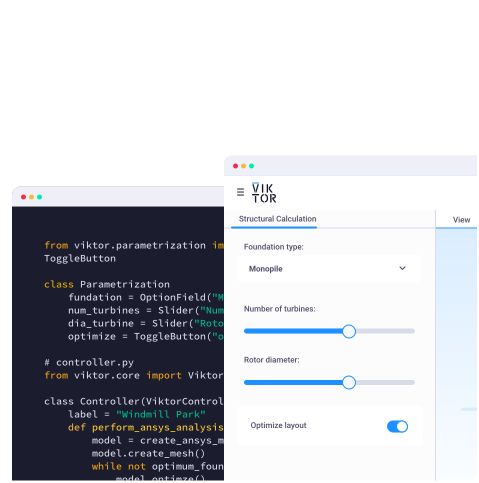
In the first demo, I showed how VIKTOR helps structural engineers take advantage of AI to build engineering apps faster, by uploading a PDF and generating the application without writing a single line of code. To demonstrate it, I recreated one of my first spreadsheet-based calculations, but this time the logic lived in the PDF. What used to take me a full day to build could be created in a couple of seconds.
You can download the following PDF and click the prompt box below to run it in the App Builder.



Footing Design App from a PDF
The second prompt I ran was to create a complete report. This connects to one of the pain points I have had during my career, having the calculation logic tied to an automatic report. Stijn and the attendees really resonated with the idea of integrating a report. You can do this with:
1
2Create a web view to visualize the intermediate steps of the calculation, Mathcad style, using MathJax to render the equations
3
Demo 2: AI agents and workflows in structural engineering
To close the webinar, I connected back to Stijn’s key point. AI should orchestrate reliable, deterministic engineering tools. I then showcased a concrete example, an AI agent that creates and runs a complete workflow to design footings from a SAP2000 model.
Workflow and tools
In this demo, the workflow was aligned with the footing design process. Each step was tied to a specific tool the agent could run, first to extract loads and support locations from SAP2000, then to run deterministic VIKTOR apps for footing sizing and rebar design.
For the deterministic design steps, the agent had access to two VIKTOR applications:
- A footing sizing app that optimizes footing dimensions based on loads.
- A rebar design app that designs the reinforcement for the selected footing geometry.
Because these tools are deterministic, the same inputs always produce the same outputs. The agent is responsible for orchestration, not “guessing” the engineering.
Running the workflow
The agent pulled information from SAP2000 using a set of tools that allowed it to:
- Extract support reaction loads from the model.
- Extract the coordinates of the supports where the footings will be located.
It then sent those results directly into the VIKTOR apps. The workflow also included a visualization tool to present outputs clearly.
Tackling changes
The key moment came when we increased the loads in SAP2000 and asked the agent to run the entire workflow again. The agent extracted the updated reactions, then reran the sizing and rebar apps with the new values, resized the footing, redesigned the reinforcement, and updated the results. The key value here is that the engineer did not need to manually reenter loads or coordinates into the VIKTOR applications, the agent handled the data flow end to end, saving a lot of time.
Join us on this journey
In this blog, we looked at the current challenges holding engineering teams back (skills and time), and why AI agent orchestration is becoming important. We also covered VIKTOR’s approach to using AI safely in structural engineering. Start with deterministic, human verified tools, then build workflows and AI agents that orchestrate those tools.
If you’d like to follow along, join us on this journey as we keep building practical, safe AI workflows for engineering and share what we learn along the way.
Start building apps for free
Related Blog Posts
September 22, 2026
Automate Civil 3D workflows with VIKTOR AI: prompts for road alignments, profiles and cross-sections
Read more
September 14, 2026
Automate AutoCAD drawings with VIKTOR AI: 3 prompts for parametric structures and details
Read more
August 27, 2026