The challenge of analysing 120,000+ data points
At the heart of the project was a large-scale geotechnical investigation involving more than 60 site investigation points. Each point required detailed analysis of Cone Penetration Test (CPT) data, a standard geotechnical method used to assess soil conditions and inform pile foundation design.
The scale of the dataset was considerable. Each CPT produced approximately 2,000 individual data readings, collected at 20mm intervals down to depths of around 40 metres. Multiply that across 60+ investigation points, and the team was faced with well over 120,000 data points to process, filter, and analyse.
The existing workflow originally relied on manually operated Excel-based tools. While functional, this approach was time-consuming, labour-intensive, and carried an inherent risk of human error particularly given the volume of data involved and the number of engineers working across the project. Quality assurance alone represented a significant burden.
With a demanding project programme, the manual workflow was simply not sustainable.
Automating and scaling CPT data analysis with VIKTOR
The application was built by AECOM’s Ground Engineering team. Upon assessing their options, they concluded VIKTOR would be the ideal platform to build and then scale an improved workflow across the ground engineering team.
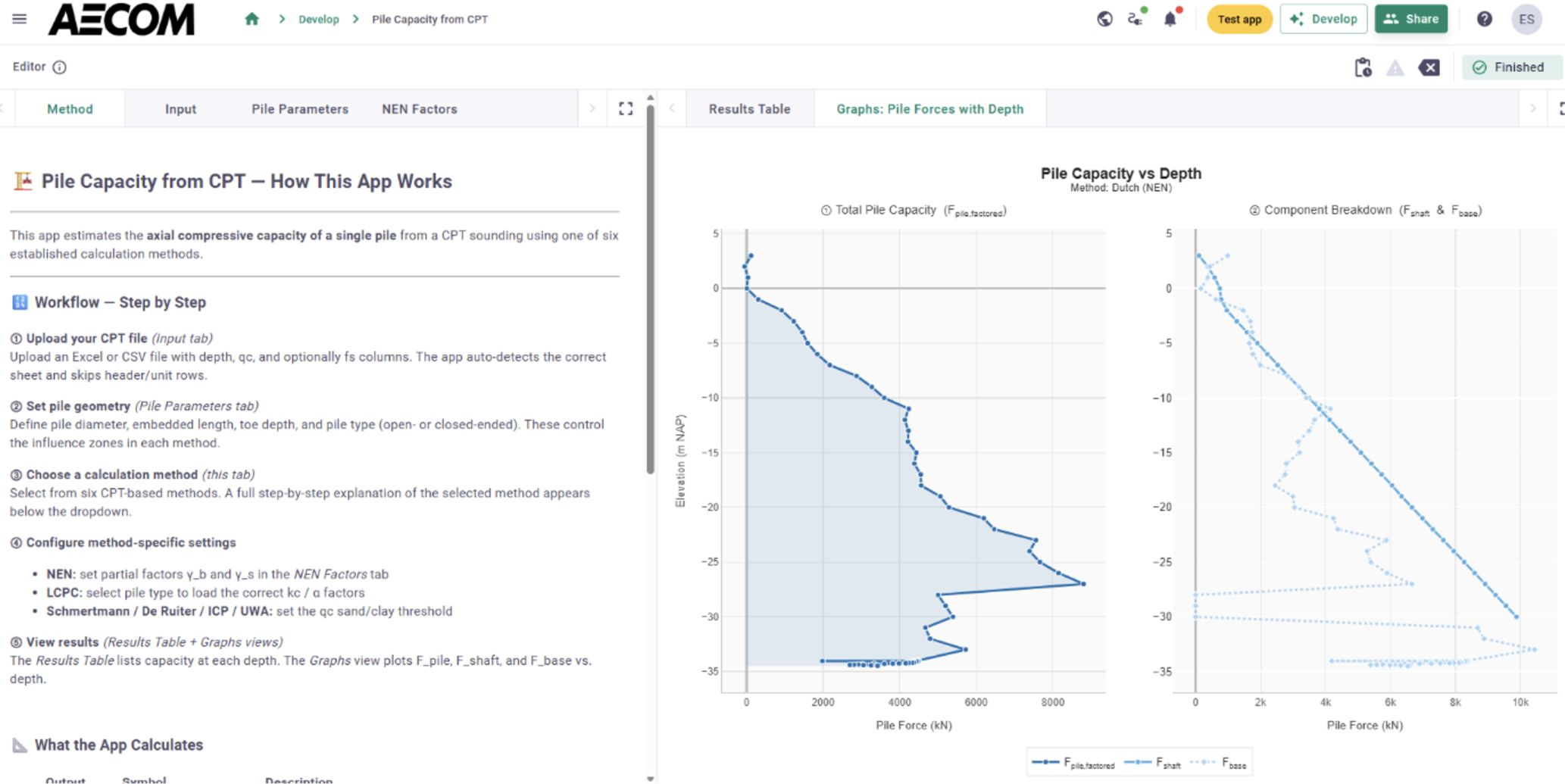
The application was built to handle the full processing pipeline, from data ingestion through to pile axial capacity calculations and integrate logic for the local Dutch code requirements. By standardising the methodology and automating repetitive calculations, the app ensured consistency across all investigation points while dramatically reducing the time required to process each one.
Supporting rapid iteration and verification
The development followed a structured approach, starting with an initial prototyping phase of a couple of weeks, followed by four weeks of user testing, feedback, and refinement loop.
In total, the application was built in approximately 50 hours of development time. A relatively modest investment given the scale of the returns. Behind this speed of delivery was something less visible but equally important: the governance framework that made moving fast, safely, possible.
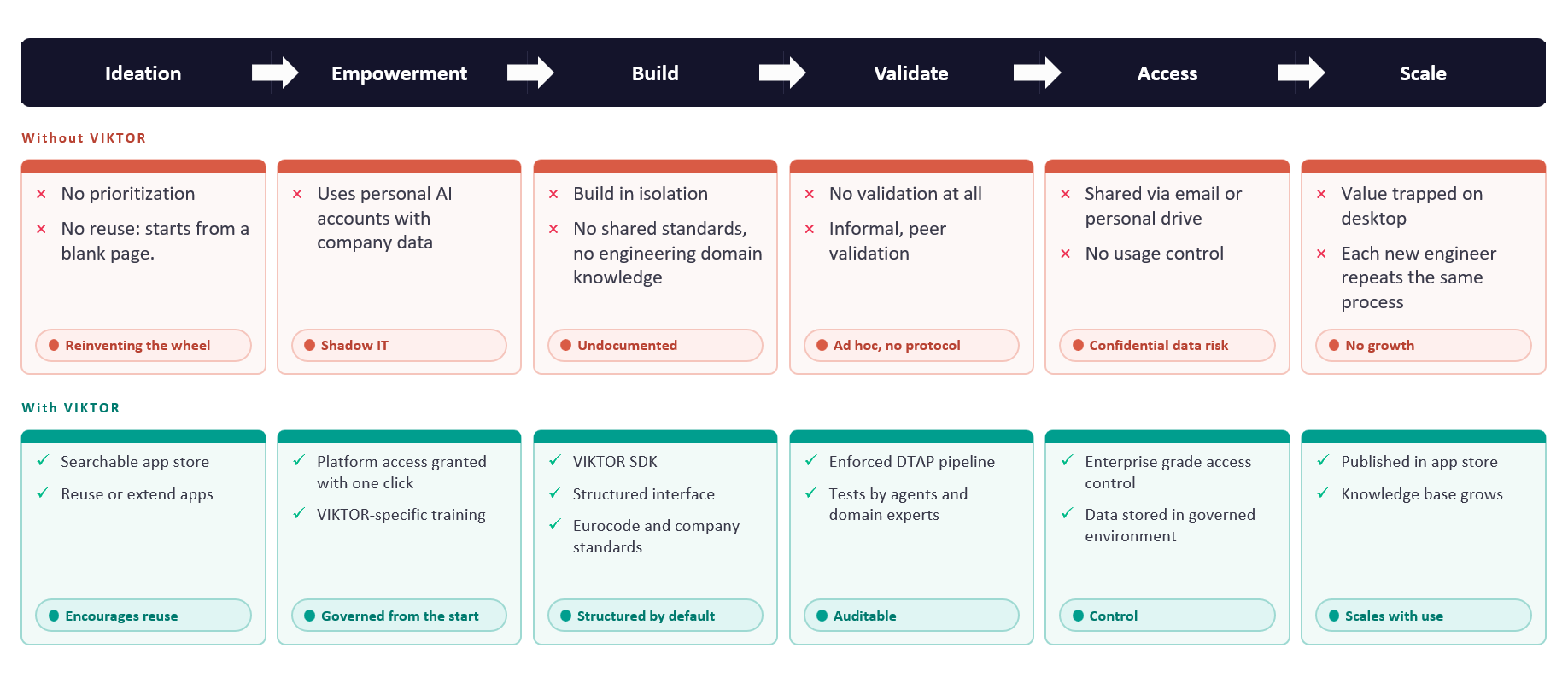
As the diagram illustrates, engineering tools built without a governed platform often become difficult to manage, audit, and scale. They are shared informally, documented inconsistently, and frequently rely on individual engineers to maintain them. With VIKTOR, access is controlled, methodologies are standardized, outputs are auditable, and knowledge can be shared across teams rather than remaining on individual desktops.
For AECOM, this meant the team could confidently test, review, and refine the application throughout development without introducing version control, governance, or data management risks. The result was not only a faster workflow, but a more reliable and scalable one, which matters enormously on a project of this scale and sensitivity.
Measurable impact across a demanding programme
The impact was immediate and measurable. Previously, processing and filtering the cone resistance data for a single investigation point could take several hours. Across a dataset of 60+ points, this added up to days of repetitive manual work. With the application in place, the ground engineering team was able to tackle the complex project timeline.
By standardising the analysis approach across the team, the application:
-
Improves reliability and consistency in outputs, giving the team greater confidence in their design calculations.
-
Enhances quality assurance, making it easier to review and verify results.
-
Frees engineers to focus on interpretation, design decisions, and higher-value tasks rather than manual data handling.
"This approach significantly improved efficiency and enabled us to deliver the project within programme and budget."

Emilly da Silva
Principal Geotechnical Engineer at AECOM
Why it worked: Key takeaways
For teams considering a similar approach, the AECOM experience offers several practical lessons:
-
Invest time upfront in design: Thinking through the workflow before writing a single line of code leads to a more structured and efficient development process.
-
Build in user testing: Trialling the app with end users early and often is essential for identifying improvements and ensuring the tool is truly fit for purpose.
-
Don't skip the QA: Peer review and independent verification of calculations is critical, particularly for engineering applications where accuracy has real design consequences.
-
Leverage the platform and its community: Leveraging a platform like VIKTOR, with its documentation, SDK, and support team enables you both the speed and quality of development and then scaling.