
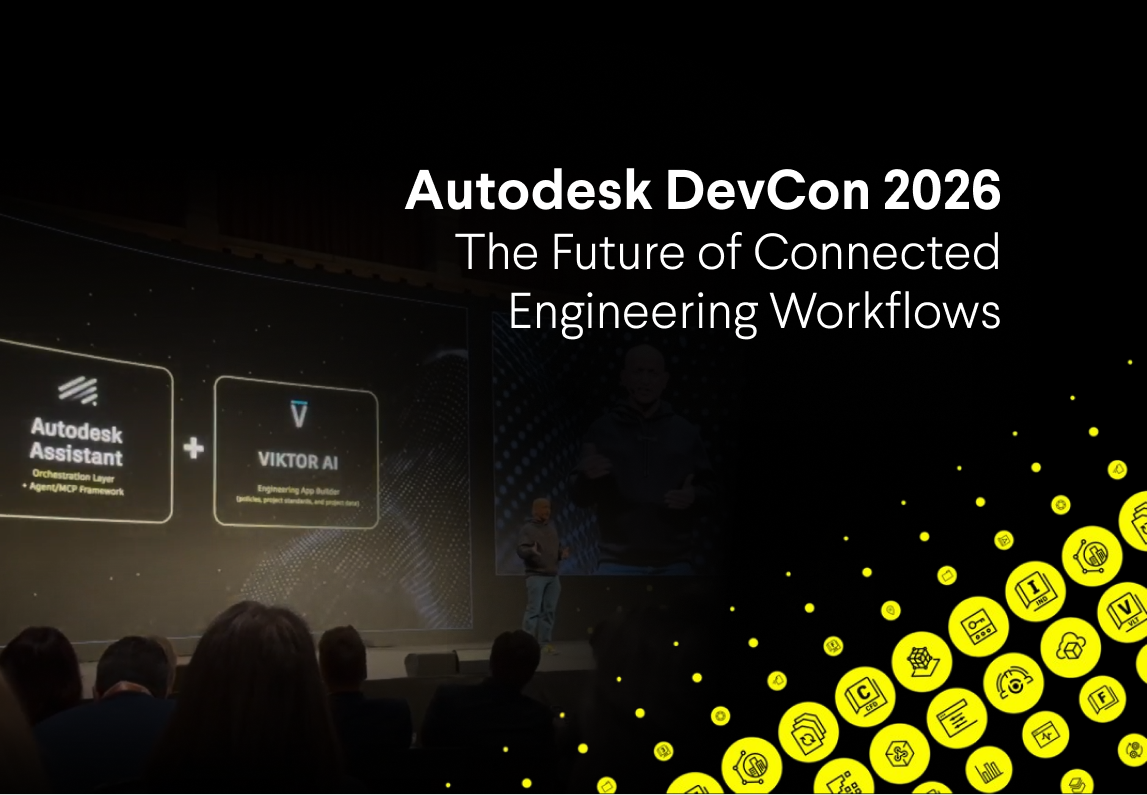
Keynote During the keynote, Autodesk showcased VIKTOR as part of an MCP integration with Autodesk Assistant, demonstrating how engineering workflows can become connected through AI and platform orchestration.
Presentation sessions Beyond the keynote, a team from HDR shared how they use VIKTOR and Autodesk Platform Services to quickly prototype ideas, build trust with users, and empower citizen developers to automate engineering tasks. In another session, Sweco and VIKTOR demonstrated live how agentic workflows can connect Autodesk Construction Cloud and other tools to orchestrate multi-step engineering processes. And in a technical deep dive, experts from WSP showed how VIKTOR can integrate directly with Autodesk’s AEC Data Model API to create cloud-native BIM workflows without requiring local desktop software.
For me, that showed something important: VIKTOR is not just aligned with where Autodesk is heading, but is already being used across the ecosystem (by Autodesk, partners, and engineering firms) to enable connected, AI-driven engineering workflows.
In the following sections, I will cover the main announcements and where VIKTOR fits in:
-
Industry keynotes: What's coming
-
New integration: Autodesk Assistant + VIKTOR MCP
-
New Autodesk Design and Make Marketplace
-
What's coming for Data APIs
-
VIKTOR in the Autodesk Ecosystem
Keynotes: from vision to real impact
The event opened with the APS keynote, Powering the Next Era of Innovation. From the beginning, the message was clear. Companies are no longer just exploring AI. They are starting to build real tools and thinking about how to scale them across teams and workflows.
Autodesk used this keynote to show how Autodesk Platform Services can help customers, developers, and partners build more connected and more intelligent solutions. The broader message was also clear: the future of Design and Make will be shaped by the combination of AI, data, and platform capabilities.
Across the keynote sessions, three ideas came up again and again:
- AI helps developers work faster and focus on higher value tasks
- Data is the foundation for useful AI applications
- Connected platforms make it easier to scale workflows across industries
VIKTOR MCP and Autodesk Assistant
The keynote's ideas around AI, data, and connected platforms became much more concrete in the next part of the presentation, when Ritesh Bansal, VP of Analytics Data, presented VIKTOR as an example of MCP integration with Autodesk Assistant.
For me, this was a special moment in the keynote because we had been working with the Autodesk team to shape this demo, and I was also asked to be the user in the story. The example was based on a very real engineering workflow. I was shown as an engineer leading an HVAC air supply project and needing to validate and update the model against company quality and efficiency standards before it could move forward.
In a normal process, this work happens across many tools. You need to extract data, run checks in external software, and fix issues element by element. It is slow, repetitive, and hard to scale. The demo showed how this changes when the Autodesk Assistant and the VIKTOR MCP work together.
The Autodesk Assistant is the place where the request starts, while VIKTOR brings the engineering logic through its MCP. From inside the Assistant, the user can identify the ducts that need attention, run the analysis, receive recommendations, and apply improvements directly in the workflow. The big advantage is that a fragmented process becomes one connected flow.
Design and Make Marketplace
Another important keynote announcement was the Design and Make Marketplace: A place where developers and companies will publish apps, agents, tools, and MCP servers so they can be discovered and used inside Autodesk workflows. This will create a more open ecosystem around the Autodesk Assistant and will make trusted AI solutions easier to find and apply in real projects.
This is where VIKTOR will bring strong value. By providing agents, tools, and MCP servers, VIKTOR will bring engineering logic directly into the Autodesk Assistant, so users will be able to run checks, analyse models, optimize designs, and generate reports in one connected workflow. Autodesk will provide the platform, and VIKTOR will bring the engineering expertise that makes it useful in practice.
Data APIs and Data Exchanges
Autodesk also shared several important updates around data access and interoperability:
- Plant3D data will be available through the AEC Data Model API in public beta
- More granular geometry access will be available through Autodesk APIs and the Data Interoperability SDK
- Revit Sync will make it possible to work with work in progress model data
- Navisworks Connector is moving to general availability, and a Civil 3D Cloud Connector beta is coming soon
- Data Exchange Live will support more real time workflows across connected systems
With the AEC Data Model API, developers will be able to work with more structured engineering data, including Plant3D access and geometry level features. These new capabilities can be used directly in the VIKTOR App Builder to create engineering apps faster on top of the APS ecosystem.
The same applies to Data Exchanges and connected workflows. Since VIKTOR already integrates well with APS, it will be even easier to connect VIKTOR apps to Autodesk data and cloud workflows with less custom work.
VIKTOR in the Autodesk Ecosystem
Many presentations also showed practical ways VIKTOR can be used inside the Autodesk ecosystem. For me, this was another strong signal that VIKTOR is not only part of the broader vision, but can also support complex workflows today through apps, integrations, agents, and engineering automation built on APS.
Here are 3 lectures that show VIKTOR in action:
- AI for Ideation: Telling a good story with Viktor.AI and Autodesk Platform Services (APS) — Watch the recording
2 Live-Building Agentic Workflows and Apps on Autodesk: turn design & engineering weeks into hours with VIKTOR AI — Watch the recording
- Cloud-Based BIM Data Access: Integrating VIKTOR.AI with Autodesk AEC Data Model API — Watch the recording
Wrapping up
In this blog, I shared some of the main ideas and upcoming developments presented at Autodesk DevCon, from Autodesk Assistant and MCP workflows to the Design and Make Marketplace, Data APIs, and Data Exchanges. These announcements create a more connected and practical ecosystem for real engineering work.
If you want to take a closer look at these topics, we will host a webinar on April 28 together with Autodesk, where we will share the main DevCon highlights and show what this new era of engineering innovation looks like in practice. As always, it will be a practical and interactive session with live demos and real engineering challenges solved live on stage. You can register here: Autodesk DevCon webinar.
https://www.viktor.ai/blog/239/autodesk-devcon-2026-ai-mcp-connected-engineering-workflows.
Related Blog Posts
September 11, 2026
Automate AutoCAD drawings with VIKTOR AI: 3 prompts for parametric structures and details
Read more
August 27, 2026
Automate QA/QC checks in ETABS with VIKTOR AI: Lessons from our structural engineering masterclass
Read moreAugust 19, 2026